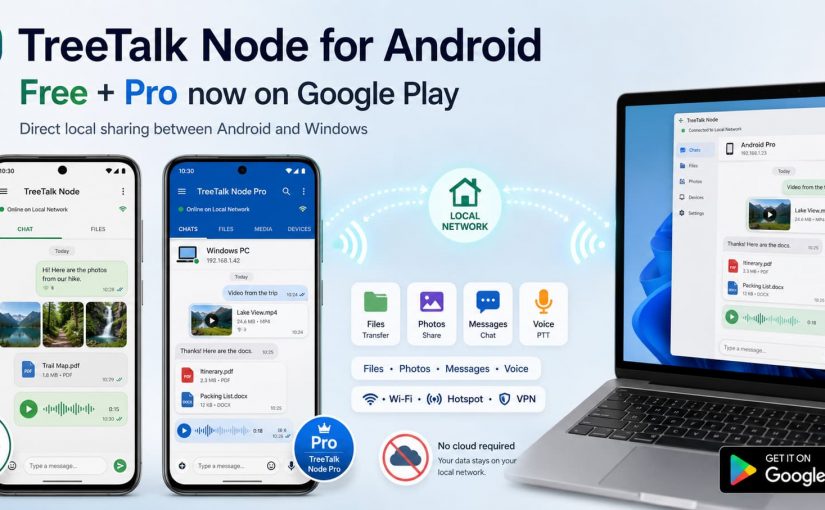
On August 18, TreeTalk Node added its second Android application to Google Play.
TreeTalk Node Free had already reached Google Play at the beginning of August. Now TreeTalk Node Pro is there as well, giving Android users a choice between a permanent Free edition and a separate paid Pro application.
Both communicate with TreeTalk Node on Android and Windows over the same reachable Wi-Fi, LAN, VPN or phone hotspot.
The basic idea has not changed: when the devices are already connected locally, files and everyday messages do not need a cloud detour.
A phone and a Windows PC can sit on the same table, yet family photos still get handed to an internet service in another country just to move a few metres.
That route may be convenient when people are far apart. It makes less sense when the devices are in the same room, on the same Wi-Fi network, and the files contain private faces, children, homes, locations or travel moments.
TreeTalk Node can transfer files directly between Android phones, Android tablets and Windows PCs on the same reachable local network. It also supports private text chat, group messages, image previews and recorded voice messages in a push-to-talk style.
Android users can now choose between two public Google Play applications: TreeTalk Node Free for ordinary local sharing and messaging, and the separate TreeTalk Node Pro app for heavier workflows such as regular multi-file sending, larger files and unrestricted outgoing voice messages.
The Android and Windows applications do not look identical. They should not. The phone uses a familiar messenger-style interface, while the Windows version keeps a compact desktop layout. The important part is that the devices can discover one another and use the same local communication flow.
TreeTalk Node Local Private Messenger and File Sharing Is Now on Microsoft Store
On July 7, 2026, Microsoft approved TreeTalk Node for the Store.
That gives Windows users two real ways to install it now. One is the portable EXE/ZIP we’ve shipped since launch. The other is the Store version, built for Windows 10 and 11.
TreeTalk Node 1.22: Secure-by-Default Local File Sharing, Better LAN Messaging, and Clearer Encryption Status
TreeTalk Node 1.22 is a practical release.
No theatrical reinvention. No features added to look good in a demo. No roadmap item invented without real evidence.
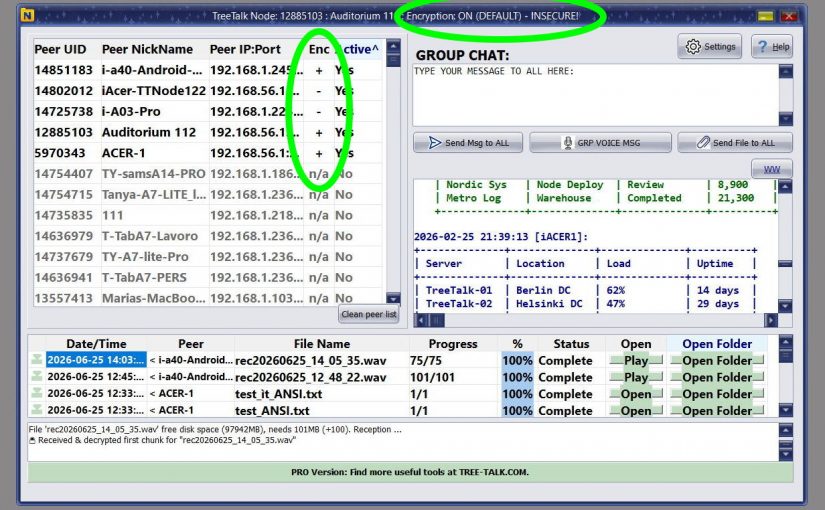
The June Release fixes the small decisions that shape real work. Group text messaging works better. Large-group message distribution is faster. Private chats are easier to read. Long user names no longer get cut off. Input fields are more comfortable to type in. Encryption status is now visible at the moment users actually need to see it.
For new installations, end-to-end encryption is enabled by default.
The common thread: every change came from real user feedback. People used TreeTalk Node in offices, laboratories, VPN environments, warehouses, and internal networks. They described where friction appeared. Version 1.22 is the answer.
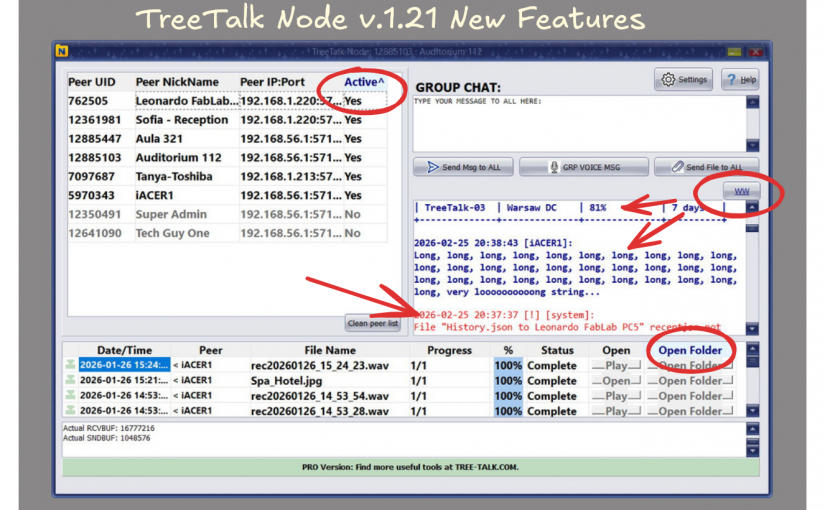
Thanks to your feedback, TreeTalk Node has received its first major update in version 1.21.
One of the unexpected advantages of agentic AI coding is how fast you can respond to user feedback. Ideas that previously sat in a backlog for weeks can now be implemented much faster. That helped us ship TreeTalk Node 1.21, our first major usability update.
We improved the contrast of the contacts panel and added tooltips to all main interface elements. The chat placeholder is now removed automatically, and peers are sorted by activity.
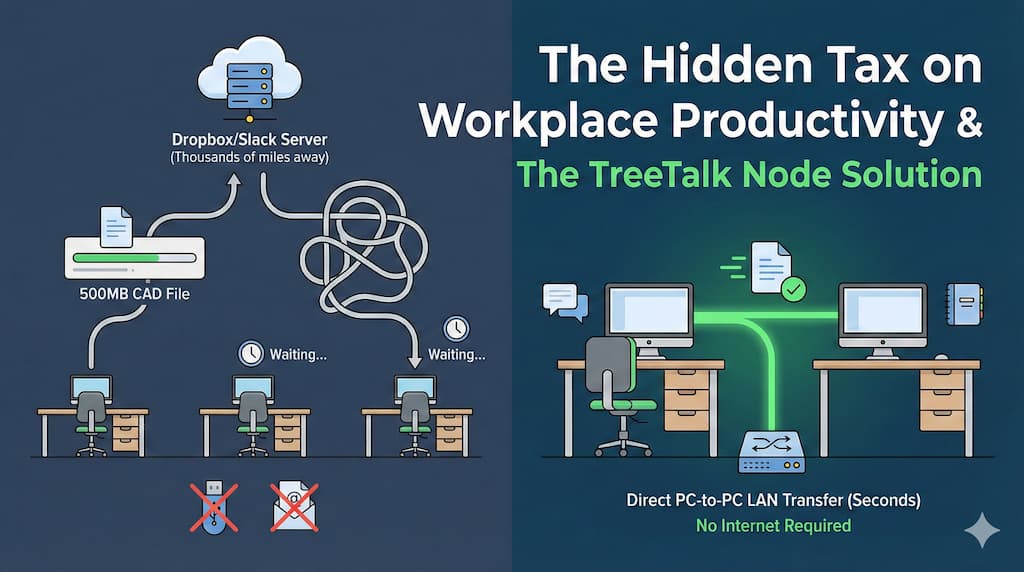
We’ve normalized something absurd in modern offices. You need to send a CAD file to your colleague three desks away. Both computers are on the same network. The file is 500MB. Logic says this should take seconds. Instead, you’re uploading to Dropbox (waiting), generating a share link (waiting), sending via Slack, while your colleague downloads it back down (more waiting) — routing a file that never needed to leave the building through servers thousands of miles away. Or you’re wrestling with email attachment limits. Or remembering which shared drive has the right permissions. Or hunting for a USB stick that’s inevitably “somewhere” when you need it most. The cloud promised to make work easier. For local file sharing, it made things worse.
Why We Built TreeTalk Node
This frustration hit home in our own workflow. Small development team, mixed Windows environment (some machines running Windows 7 for legacy testing, others on Windows 11), frequent need to move builds, logs, design files, and documentation between systems.
TreeTalk Node: Faster Ways to Send Large Files
Cloud tools felt like using a forklift to move a coffee cup. We didn’t need synchronization, version control, or global access. We needed something simpler: send this file to that person, right now, across our local network. Traditional solutions all had dealbreakers:
SMB/network shares require IT configuration most users can’t do themselves, and discovery is terrible (“Is Bob’s machine \DESKTOP-X7K2 or \BOB-PC?”)
FTP/file servers need dedicated infrastructure and someone to maintain it
P2P sync tools (Syncthing, Resilio) are built for continuous folder synchronization, not quick interactive transfers
Legacy LAN messengers have outdated UIs, poor file handling, and security practices from 2005
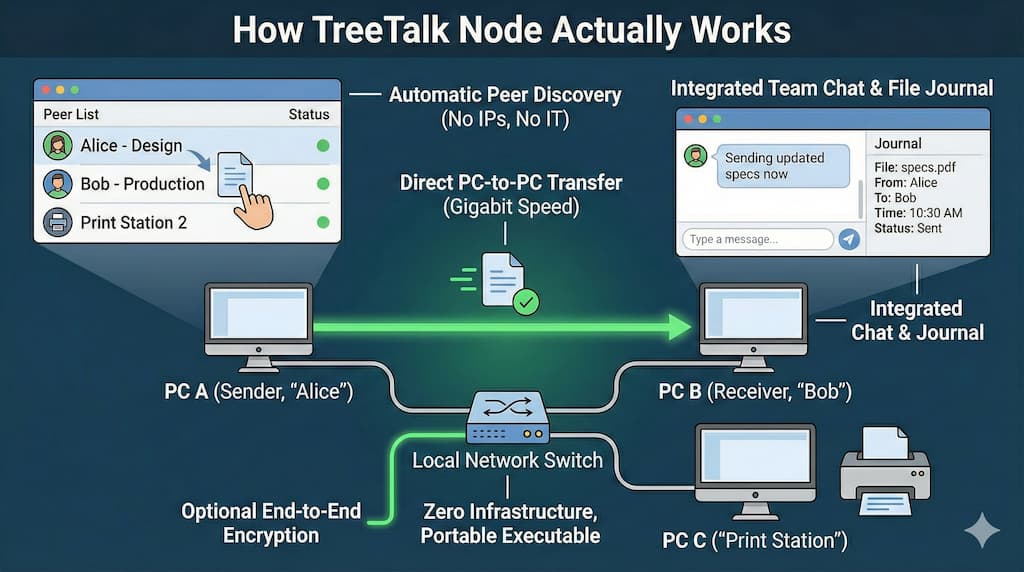
We wanted something that worked like this: open app, see “Bob – Workstation 3” in the peer list, drag file, send. Done. So we built TreeTalk Node — offline-first file transfer and team chat for Windows PCs in local networks.
How It Actually Works
TreeTalk Node treats your local network the way it should be treated: as a fast, private space you already control.
TreeTalk Node: Faster Ways to Send Large Files
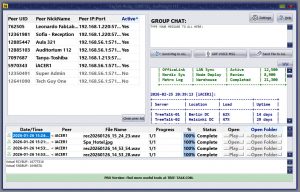
• Automatic peer discovery means the app finds other TreeTalk Node instances across your LAN, Wi-Fi, or VPN within seconds. No IP address configuration, no network mapping, no IT tickets. Just human-readable nicknames: “Alice – Design”, “Bob – Production”, “Print Station 2”. • Direct PC-to-PC transfers use the full capacity of your local network — typically 100 Mbps to 10 Gbps depending on infrastructure. A 2GB video file that would take 15 minutes via cloud upload/download moves in under 30 seconds on a gigabit LAN. • Integrated team chat sits alongside the peer list. Quick coordination (“Sending updated specs now”) without switching apps. Group chat for project team, private messages for one-on-one communication. • File journal logs every sent and received file with timestamp, sender/receiver, and quick access buttons. Opens the file or containing folder instantly. Critical for compliance, auditing, and just remembering “where did that report go?” • Optional end-to-end encryption for environments where regulatory requirements or shared infrastructure demand it. For small offices where simplicity matters more, unencrypted mode removes complexity (and works faster). • Zero infrastructure requirements — no dedicated servers, no NAS, no cloud subscriptions. Works on existing network hardware you already have. • Portable executable means no installation, no admin rights needed, no IT deployment headaches. Copy the .exe to a USB drive, distribute via email, or drop it in a shared folder. Users just double-click and they’re connected. • Windows 7 SP1 through Windows 11 support matters more than you’d think. Manufacturing plants, logistics hubs, point-of-sale terminals, warehouse management systems — the real world runs on mixed fleets where “just upgrade everything” isn’t an option. Watch how it works in practice: Demo Video
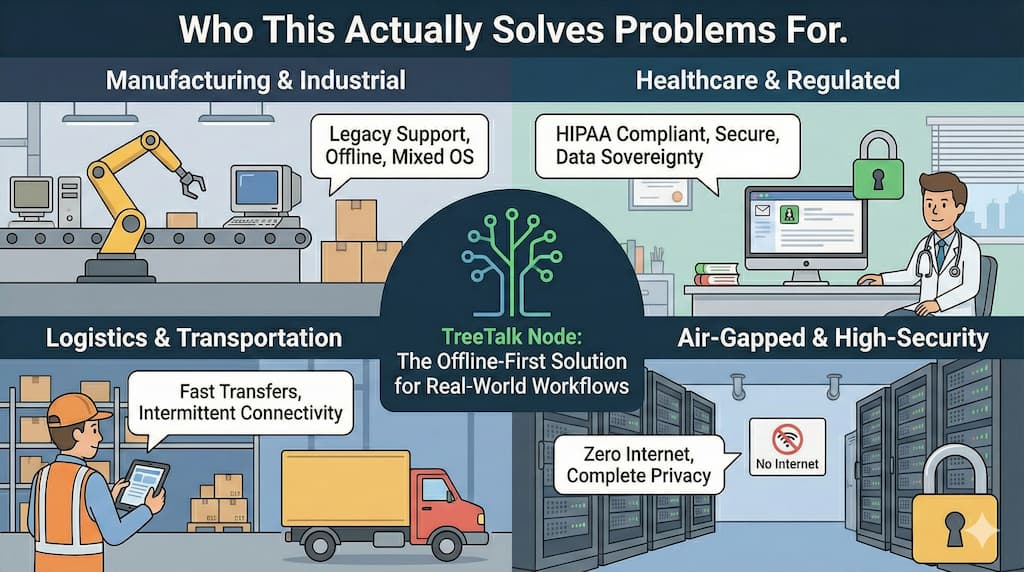
Who This Actually Solves Problems For
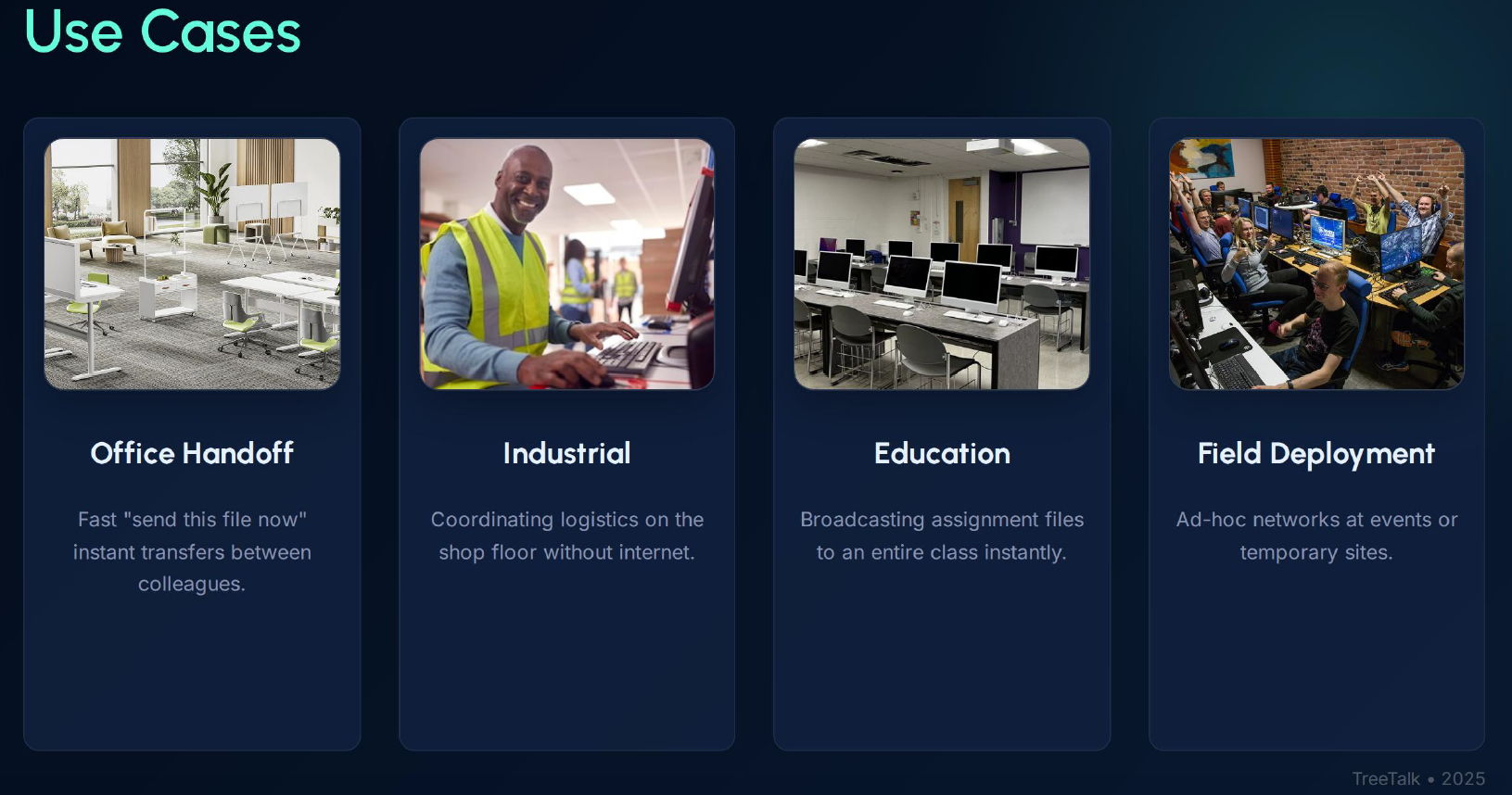
TreeTalk Node Private Local Network File Sharing Use Cases
Creative & Development Teams
Workstations exchanging large design assets, source builds, project archives, media exports, and test datasets. Mixed environments (Windows/macOS/Linux), shared WiFi and wired LAN, VPN links between offices or remote teammates, and workflows that can’t wait for cloud sync or upload limits. TreeTalk Node fits the real pipeline: fast peer-to-peer transfers, no cloud dependency, works across VLANs with proper routing (or over VPN as a LAN), and runs on everyday hardware without changing how your team works.
Manufacturing & Industrial Operations
Shop floor computers exchanging production schedules, quality control reports, machine configurations. Often older Windows installations, segmented networks for security, unreliable or non-existent Internet connectivity. TreeTalk Node handles the messy reality: no cloud dependency, works across VLANs with proper routing, runs on decade-old hardware.
Logistics & Transportation
Dispatch centers sending route manifests and delivery updates to driver terminals. Warehouse systems exchanging inventory reports. Field offices with temporary network setups. Fast transfers of time-sensitive documents without relying on external connectivity.
TreeTalk Node: Faster Ways to Send Large Files
Healthcare & Regulated Environments
Medical offices, labs, clinics where HIPAA compliance makes cloud tools risky and expensive. Patient data, imaging files, lab results staying strictly within the local network perimeter. Optional encryption plus audit logs for regulatory documentation.
Education & Training
Computer labs where teachers need to distribute assignments to 30 student machines simultaneously, or collect completed work back. No student accounts to provision, no cloud storage quotas to manage, no Internet bandwidth bottlenecks during class.
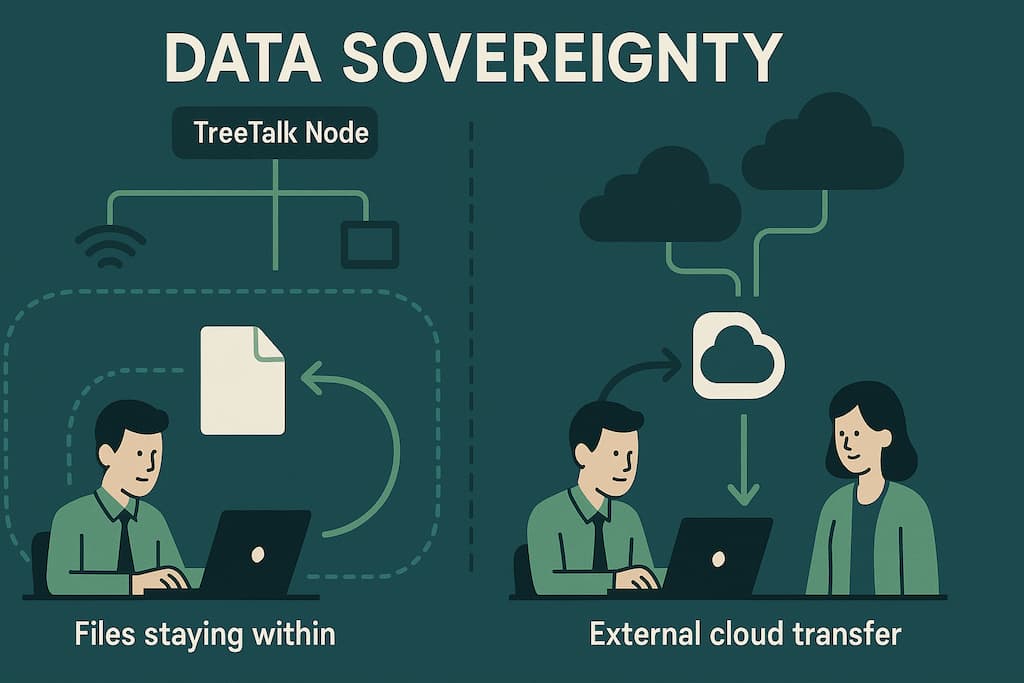
TreeTalk Node Private Local Network File Sharing Data Sovereignty
The Data Sovereignty Advantage
Here’s what doesn’t happen with TreeTalk Node:
Your files don’t pass through third-party servers
No company in another jurisdiction can access your data
No metadata harvesting for analytics or advertising
No surprise terms-of-service changes affecting your workflow
No “we’re shutting down this feature” announcements
For enterprises navigating GDPR, CCPA, industry-specific regulations, or simply internal security policies, this matters. The compliance story is simple: files never leave the network perimeter you control. For investors, this positions TreeTalk Node in the growing market for data sovereignty solutions — businesses actively seeking alternatives to surveillance capitalism business models.
TreeTalk Node – P2P Local-First Chat & File Transfer messenger
What Happens Next
We’re refining TreeTalk Node based on real-world usage in our beta program. We’re especially interested in feedback from:
IT managers deploying in mixed or restricted environments
Operations teams in manufacturing, logistics, or field services
Compliance officers evaluating data residency solutions
Anyone tired of using cloud tools for purely local file transfers
Take our 60-second survey and get early beta access + two months of premium features free:https://tally.so/r/WOOgRJ
The questions we’re most curious about:
What makes file sharing convenient for your specific workflow?
What slows you down most with current tools?
Which features matter most in your environment?
Frequently Asked Questions
1 How to Share Large Files on a Local Network (LAN) or Wi-Fi Network
For transferring large files from hundreds of megabytes to multiple gigabytes (like CAD files, Full HD videos, BlueRay movies or 4K Ultra High Definition content), TreeTalk Node provides the most convenient solution.
Just drag and drop files onto a recipient’s nickname or group chat, or click the “Send File” button. Files transfer directly between computers without touching the internet, making it much faster and more secure than cloud storage — ideal for critical infrastructure and air-gapped networks.
2 How to Transfer Large Files Over the Internet
For transferring large files (hundreds of megabytes to several gigabytes) over the internet, combine TreeTalk Node with a VPN service.
VPN solutions like OpenVPN or SoftEther create secure encrypted connections between devices. TreeTalk Node recognizes this VPN tunnel as a local network and automatically discovers other devices as if they were on the same LAN.
Simply drag and drop files to the recipient or use the “Send File” button. Files are delivered peer-to-peer without cloud services or online storage, ensuring faster speeds and better security.
3 Do I need the Internet or a server to use TreeTalk Node?
No. TreeTalk Node operates entirely within your local network.
Internet access, cloud accounts, and central servers are not required.
Everything—file transfers and messages—remains within your LAN, WiFi, WiFi Halow, or VPN environment, delivering superior privacy, speed, and reliability even in offline or isolated network scenarios.
4 Will TreeTalk Node work on older Windows systems like Windows 7?
Yes. TreeTalk Node is compatible with Windows 7 SP1 through Windows 11.
It’s specifically designed for mixed-age environments where legacy and modern systems work side-by-side—perfect for offices, manufacturing facilities, educational institutions, and home networks with varied hardware configurations.
5 Is TreeTalk Node safe to use for sensitive files?
Yes, completely safe.
TreeTalk Node confines all transfers to your internal network and provides optional end-to-end encryption when extra security is needed.
Your files never leave your network perimeter, no external servers are involved, and you maintain complete control over your data at all times.
6 Do I need to install anything or configure networks?
No installation or configuration necessary.
TreeTalk Node runs as a portable executable:
Download it to your devices,
Double-click to launch,
Watch it automatically find peers on your network.
No driver installation, no firewall modifications, no IT deployment complexity—it simply works out of the box.
7 How fast is file transfer in TreeTalk Node?
Transfers leverage the full bandwidth of your LAN, WiFi, or VPN connection, eliminating the bottlenecks created by cloud services and protocol overhead.
Files move peer-to-peer between computers at native network speeds—consistently outperforming email attachments, messaging apps, SMB shares, and USB drives, particularly when moving large files.
TreeTalk builds communication infrastructure for environments where privacy, security, and independence matter. TreeTalk Node is our answer to the question: “Why is sending a file across the room harder than sending it around the world?”
TreeTalk has begun conducting the real-life tests of the voice terminal. Now the prototypes are being tested in the cars, which is riding around the city and near suburbs in a mode of normal use. Thus, during parking, warm-up and on the move the terminals are subject to temperature extremes from -30 to +20 Celsius (-22 to +68 Fahrenheit). All this time, the built-in audit system records the slightest failures in the network connection, the electronics and embedded firmware.
First trial run confirmed all of the declared advantages of TreeTalk solution. Yes, it still looks like a professional (conventional or trunked) two-way radio. It inherits the pluses of LMR/PMR: broadcasting, constant connection, instant calls, and simplicity. Additionally, TreeTalk adds its own features.
The differences are becoming clear from the very beginning.
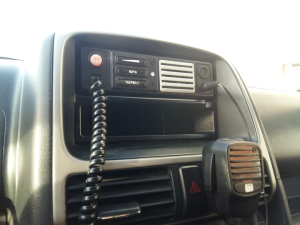
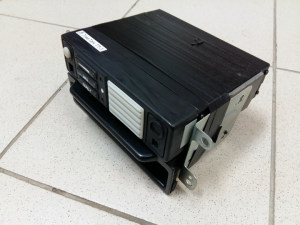
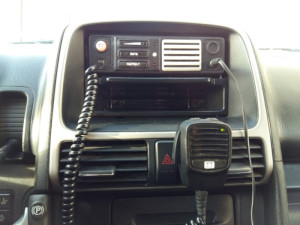
First, users of the TreeTalk devices do not need to spend time and effort to complex mounting. The device fits the standard 1-DIN slot perfectly and there is still enough place remaining for the car audio. Professional transceivers are heavy and usually hot. They are energy consuming, thus require dedicated power line from the car battery, made of thick wires. In contrary, TT terminal is light in weight and require minimum power (0.5 Amp). It is omnivorous (10-26 V), so did not require any special DC-DC converter. Its installation is easy, because our specimen has not any wires or connectors on the back panel to connect somewhere.
Strict design looks good in the dashboard of the car. Frontal speaker gives a sound loud enough, even on the medium volume level.
Second, TreeTalk terminal works without any external antenna. Radio hobbyists and professionals know that antenna, sticking out of the car top, is a weak spot and eternal headache. It is always going to be lost or broken, and the cable tends to be tangled and torn. So no antenna – no problem.
Third, the terminal is very friendly. All manipulations with the buttons are accompanied by signals or voice announcements (in English). If you miss the last message, led indicates that it is recorded — you can just push ‘REPEAT’ button to listen to it. (If you did not understand or resolve some important information, you can make that again).